
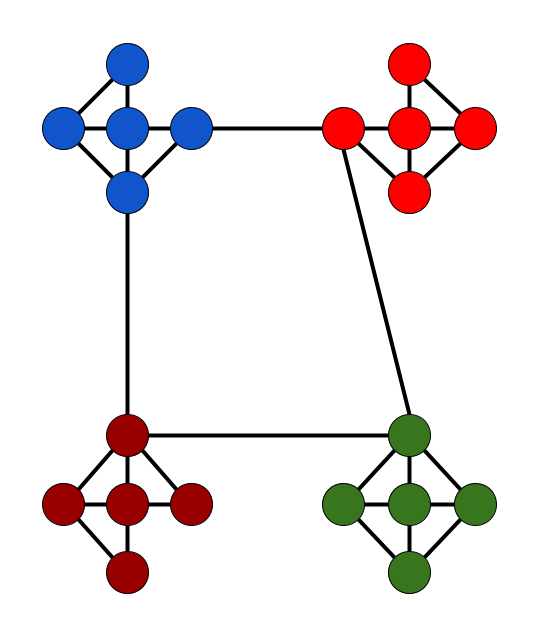
Cellular sheaves are a generalization of graphs that enable higher-dimensional linear relations between nodes. Their associated sheaf Laplacians are local linear operators on graphs and thus of great value in distributed settings where independent agents must strive towards consensus. Consequently, cellular sheaves are a natural structure for expressing complex consensus constraints in distributed optimization problems (known as homological programs). My research so far in this field has focused on developing and implementing efficient distributed optimization algorithms for homological programs as well as searching for novel applications in domains such as multitask machine learning, PDE solving, and multi-agent control. Future work will include decomposition methods for homological programs and formalizing the connection between homological programs and composite optimization problems introduced in my other project.